Showing posts with label detail. Show all posts

Wednesday, November 10, 2010

Diagrammatic Analysis through Articulated Edge [Part II]


The articulations on the constructions of Uxmal not only narrated a story and decorated the site, but also created a well-define edges with an organized itinerary. This model is a diagrammatic representation of the edifice between the Pyramid of the Magician and the Nunnery Quadrangle, constructed accordingly from the regulations and the surfaces present at the site of Uxmal.

Monday, November 8, 2010

Diagrammatic Analysis of an Articulated Edge [Part I]

The articulations on the constructions of Uxmal not only narrated a story and decorated the site, but also created a well-define edges with an organized itinerary. This model is a diagrammatic representation of the edifice between the Pyramid of the Magician and the Nunnery Quadrangle, constructed accordingly from the regulations and the surfaces present at the site of Uxmal.

Wednesday, October 13, 2010

Theory: Articulations vs. Circulation


The articulations of the ruins suggest the circulations of the site. These articulations and the designs of the façades, doors, gates, and walls of the temples stand out greatly (all of which is shown on this particular plan diagram). As such, these articulations allow archeologist to have a deeper understanding of the planning and the organization of Uxmal. The articulations, stories and the symbolisms on the temple’s walls also indicate the main inhabitable spaces and paths (where inhabitants could follow, view, and appreciate these designs on a well-define edges of the edifice). Both the defined spaces and paths contribute to the finding of the site’s main circulations.

Tuesday, October 12, 2010

Theory: Levels of Detail


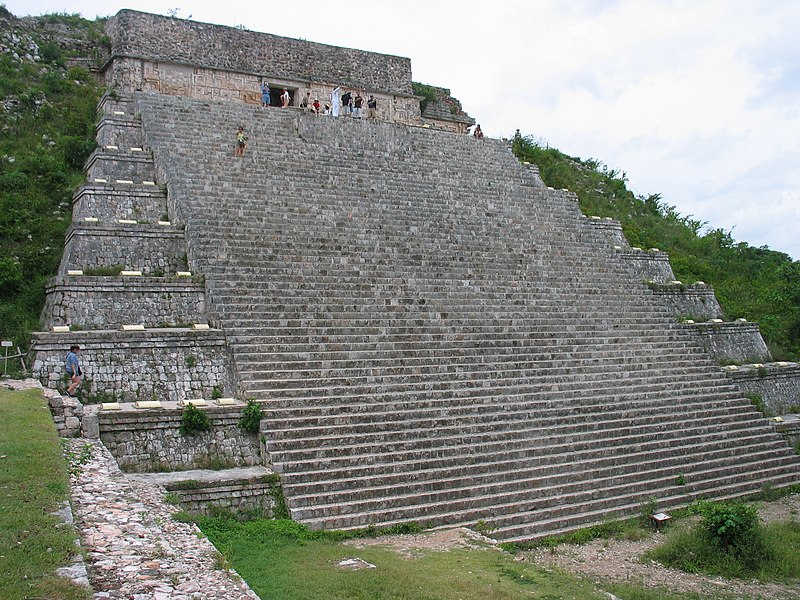
Most Mayan ruins are not known for a high level of detail. In fact, they are most often known for the large masses from which they are built. However, Uxmal is known for quite the opposite. Although the first level of most buildings is made from flat stones, the second level is usually adorned with a ornate details not present in most other mayan ruins. The details are often representative of many different gods but often depicted to the god Chaac, the god of rain. Also the presence of the "mosaic ornament of Puuc buildings has long suggested motifs of textiles, particularly given the sorts of repeating geometric patterning that covers facades like tapestries."


Information taken from: Maya Art and Architecture, Mary Ellen Miller (London: Thames and Hudson Ltd. 1999), pg 61

Monday, October 11, 2010

Theory: Contrast Between Mass and Detail

The scale of Uxmal ranges from large masses that construct buildings to minute details that convey the cultural influences of the time period. The contrast between the mass and detail is very apparent at Uxmal. The juxtaposition of the huge spaces between buildings and the large buildings themselves imply importance and authority.

In contrast, the finely detailed facades on many of the buildings depict interwoven serpents, lattice work, and masks of the rain god, Chaac. These are representative not only of Uxmal itself because they are found everywhere, but also of Puuc architecture in general, thus representing the past and serving as a sort of time line of cultural patterns.

diagram of Magician's Pyramid

Theory: Palimpsest


1. The site is very carved into, and the surfaces of the buildings contain a vast amount of details and information about the Mayan culture and the daily life patterns of that time; how they were heavily influenced by the cosmos, and how their religion affected how they built. They constantly built on top of their old structures and added more and more as time progressed, signifying perhaps an idea of the cycle of life. Birth, death and rebirth. In this sense the temples act as a palimpsest. Layer upon layer of ideas, information about their culture at the time, religious practices and sacrifices, ideas and memories of its people. This also establishes an idea of hierarchy within the construct itself.


2. Not only were the Mayans influenced by their beliefs and culture, but the landscape of the Uxmal site has also been carved into, or at least gives the appearance of having been carved out of the hills. Their temples and constructs look as though they belong to the site. Even though one of the buildings is on a man made hill, the main temple looks as though it was carefully dug out of the environment.

Theory: Symbolisms within the details of the Ruins of Uxmal


Uxmal is one of the many ruins in the Mayan Kingdom, one of many which the details and the concepts of the site also embody and portray their society and culture. The design and development of the site of Uxmal also demonstrates their complex understanding of city planning. Many details, such as stone mask of Chac, the Mayan Rain God, that are sculpted on the wall of the site, are not only for decoration but also meaningful and symbolizes their civilizations. The symbolisms represent directly to their lifestyle and their practice of religion. The process of construction and the integration of these details into the wall of the temple demonstrate their understanding of structure and even suggest their understanding of city planning…