
Showing posts with label Lis. Show all posts
Showing posts with label Lis. Show all posts
Monday, December 13, 2010


Friday, November 19, 2010
Client and Program: Itenerary through a Ceremonial Ritual


 Client: Worker/Craftsman
They have an intimate relationship with the artifact. They shape, mold, and chip away at its surface to give it shape, life.
Client: Priest(s)
These clients interact with the craftsman to assure that quality work is done, and that all prerequisites are met before, during and after construction of the ceremonial piece.
Conclusion after much speculation based off of readings, research and Mayan wall paintings:
I've speculated that the Maya would not simply just create an artifact for tribute to the gods and just bury it without much thought, celebration, or without having some kind of formal ritual or procession. With this in mind I think the king would have probably ordered the best craftsman in the village, or tribe and ask him to create tribute worthy of the gods. The bringing about of this act would probably be caused because of a drought, thus affecting the health, wealth and power of the village's people. By offering tribute the Mayans sought to appease the gods, and in return end the drought or sickness even that may have been plaguing their people. during the creation of the tribute I've speculated that priests, or maybe even the king himself, would pay the craftsmen a visit to insure that everything was going according to their plan. Upon finishing the ceremonial piece, I believe that the kind would have held a formal procession, or event, maybe even a celebration, in order to send the artifact down to the gods in hopes of appeasing them.
Thursday, November 11, 2010
Artifact: Eccentric Flint Head of Ka'wiil

The materials flint and obsidian were used very heavily in the average every day life of the Mayans. They shaped these materials over a stone work bench, or hard surface, chipping away laboriously at the edges, and manipulating the surface to give their work a shape, structure, form.
These large chunks of obsidian or flint would eventually be worked into a weapon, jewelry items, or in this case ceremonial items.
This eccentric flint head is meant to be buried, a ceremonial offering to the gods in Shibalba. Shibalba is located roughly in a cave near Coban traditionally speaking. (Mayan Religion) Because this flint head was originally buried within the site itself (probably because the traditional site of Shibalba may have been too far away), there suggests a kind of relationship with the ground.
The god Ka'wiil is known as a deity of thunder, usually depicted with an axe or a torch through his head. The Mayans thought that thunder was basis for creating life. When thunder struck, it would rain, and the maize seeds, which the Mayans thought to be the life of their people, could grow and give birth to new life.
A cycle of birth, life, death, and rebirth. A constant circle. All occurring in relationship to the ground.
Wednesday, November 10, 2010


Monday, November 8, 2010
Digital Rendition of Uxmal Edge Construct

A Diagrammatic representation of a pathway intersecting the plane that holds the Governor's palace and the House of the Turtles. The model is showing an edge condition that is created when a section cut of all of the constructs on the platform are merged together. It is laid out horizontally across the natural edge of the platform, and is experienced in a perpendicular movement through the threshold created by the space in between.
Monday, October 25, 2010
WaterColor Digital Rendition of Uxmal Theories

The idea of a moving palimpsest through varying layers of constructions that establish a chronological memory of previous constructions and previous life of the Mayans resonates throughout the site.
A heavily carved into, as well as built upon, landscape creates a level of hierarchy.
The land is raised and carved into in varying layers, thus creating layer upon layer of information. The pyramids themselves are also split up into varying layers of elevation as new constructions are built over and integrated into old ones. This variance in scale sets up a moment of hierarchy not only within the building, but amongst the Mayan people as well. The king, surrounded by upper class citizens, or servants would sit atop the highest plat form and preside over his people. This is very much the same for the temple. The new construction presides over the old conserving a memory of time, as well as establishing a type of internal hierarchy that can only be guessed at from the outside.
The site itself is oriented towards the Mayan's highly revered deity Venus. The entire site resonates a certain rhythm of non-equilateral geometric shapes resembling mostly trapezoids and rhombus'. These shapes do not appear to be perfect squares as ones eye would most likely be accustomed to see, but instead are slanted by varying degrees. These varying slants are actually quite apropos, because they are oriented to line themselves up with a cosmological sign in the sky, as well as to direct the central axis of their site towards Venus.
This only adds to the layers of information that their site contains about their life and culture. The varying constructions themselves also add a challenge to the relatively horizontal movement that takes place in the site of Uxmal. When experiencing any of the varying constructions in the site the eyes are drawn towards the sky; even the path you must take to reach the end of the construction is strictly vertical. This vertical movement challenges a mostly horizontal path that is laid out as the general plan for the site.

Wednesday, October 13, 2010
Theory: Orientation


Many Mayan Ruins are oriented in a skewed manner mostly due to the interruption of the natural environment on their living space.
The Uxmal site however has a consistent pattern or slant throughout it's site. This slant is due to the alignment to the Uxmal's people highly revered deity Venus. Venus appears due south, and thus the entire site is oriented due south, regardless of an encroaching forest.
This carefully planned orientation throughout the entire layout of the site shows how heavily influenced the Maya were by their religious beliefs and practices.
Vocab Words
- Dovecote
- Roof Combs
- Mosaic
- Hieroglyphic
- Stelae (Tetun)
- Step Pyramid
- Urbanism
- Cenote
- Quadrangle
- Cistern
Theory: Influence of Topography on Mayan Architecture

The entire Uxmal site is surrounded by a large and heavy forested area. The natural landscape acts as a barrier or gate around the site of Uxmal. Many of the buildings were built based on Mayan religious beliefs and practices, such as orienting towards the south where Venus is, as well as having large palaces and temples for the king and then for the Mayan people.
The issue of an en
 croaching landscape did not seem to hinder the Uxmal people at all in the construction of their buildings. They simply built into the landscape. Over head shots or side views of the site depict this idea of building with nature instead of having nature conform to us. This method of building when taken in aerial view makes it appear as though the Uxmal site is almost completely isolated from outside invasion or disruptions.
Theory: Hierarchy of Preservation
 Mayan buildings were normally built right over each other, each previous temple presiding below the newly constructed one on top. As they built anew, the temples and buildings became larger and larger. This increase in scale sets up a moment of hierarchy not only within the building, but amongst the Mayan people as well. The king, surrounded by upper class citizens, or servants would sit atop the highest plat form and preside over his people. This is very much the same for the temple. The new construction presides over the old conserving a memory of time, as well as establishing a type of internal hierarchy that cannot be seen from the outside.
Theory: Transformation of Void into Armature

The Mayans designed the layout of their buildings to suit not only a large population, but also to fit into the natural landscape as well as align with Venus.
Many of the buildings are on varying different levels or set right into the hills. This leaves a large stepped and leveled plane in between. This plane can be considered a large open gathering space, however when taken into a side view the varying levels of this void come together to create an armature that acts as the connective tissue of the entire site.
Artifact

The artifact to the left is called the Eccentric Flint Head of Ka'wiil. Ka'wiil is known as one of the Mayan gods, and is represented here with an axe in his head. The reason for this is because the Maya believed him to be the lightning god and hitting an axe creates sparks if struck against another metal.
The use of these flints are debatable, however research shows that they were most likely used as religious offerings or as scepters because they would be buried beneath buildings or sculptures.
These flint heads are very representative of Mayan work, and like architecture are a constructed thing that hints or symbolizes many different aspects of a culture.
Monday, October 11, 2010
Theory: Palimpsest

1. The site is very carved into, and the surfaces of the buildings contain a vast amount of details and information about the Mayan culture and the daily life patterns of that time; how they were heavily influenced by the cosmos, and how their religion affected how they built. They constantly built on top of their old structures and added more and more as time progressed, signifying perhaps an idea of the cycle of life. Birth, death and rebirth. In this sense the temples act as a palimpsest. Layer upon layer of ideas, information about their culture at the time, religious practices and sacrifices, ideas and memories of its people. This also establishes an idea of hierarchy within the construct itself.
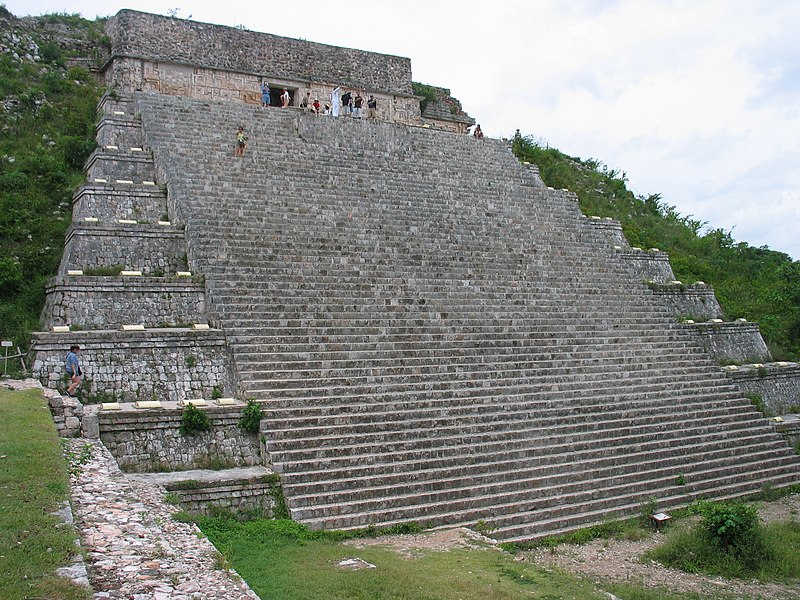
2. Not only were the Mayans influenced by their beliefs and culture, but the landscape of the Uxmal site has also been carved into, or at least gives the appearance of having been carved out of the hills. Their temples and constructs look as though they belong to the site. Even though one of the buildings is on a man made hill, the main temple looks as though it was carefully dug out of the environment.
Subscribe to:
Posts (Atom)